
Carroll Deeds and Their Roles
Land instruments in Carroll County are recorded by the Circuit Court Clerk. A typical deed names the grantor and grantee, lays out the legal description, and may point back to an earlier deed or plat. Recording puts the world on notice of the instrument, but it does not certify that no competing interest exists.
| Deed Type | What It Does | Common Use |
|---|---|---|
| General warranty | Conveys an interest with broad covenants | Ordinary sale |
| Special warranty | Limits covenants to the grantor's period | Commercial or fiduciary transfer |
| Quitclaim | Conveys whatever interest exists | Correction or family transfer |
| Trustee or representative | Conveys under stated authority | Trust, estate, foreclosure |
| Corrective deed | Repairs a stated earlier defect | Name or description correction |
A mortgage or deed of trust secures a debt. A release clears that lien. Neither one conveys ownership, so do not confuse either with the deed itself.
Search MDLandRec Controls
A free account unlocks MDLandRec. If you already hold a deed reference, enter it as county, book, and page. Party searches can be narrowed by individual or corporation, grantor or grantee, legal capacity, instrument type, remarks, cross-reference, and date.
| Control | Choice | Use |
|---|---|---|
| Party type | Grantor, grantee, all | Separate conveying and receiving roles |
| Ownership | Individual, corporation, all | Find people or entities |
| Instrument | Text filter | Narrow deed, release, easement, lien |
| Date | Range, before, after, exact | Reduce unrelated entries |
The official field guide is shown below.
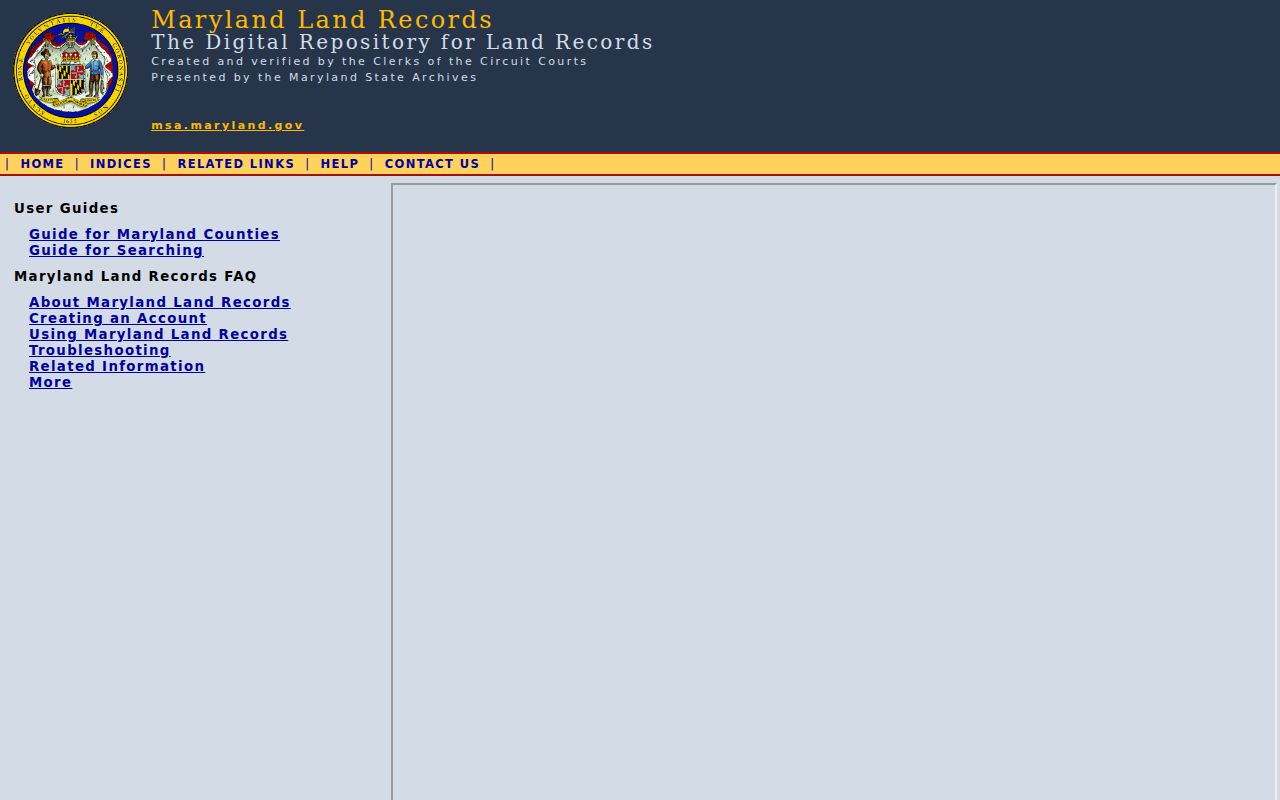
Partial and fuzzy name controls help catch spelling variants, and legal capacity filters can isolate a trustee or representative.
Walk Carroll's Grantor-Grantee Chain
Begin with the current SDAT Deed Reference. The prior-conveyance clause inside that deed tells you where to look next. Flip roles as you go. The grantor in one deed becomes the grantee in the one before it. Keep repeating the process while the legal description stays consistent.
- Open the current deed by book and page.
- Record parties, dates, legal description, plat, and prior citation.
- Search the prior grantor as a grantee near the earlier date.
- Check corrective, trustee, estate, merger, release, and easement branches.
- Move to archive indexes when the direct electronic index ends.
- Grantor
- The party conveying an interest.
- Grantee
- The party receiving the stated interest.
- Chain of title
- The linked sequence of conveyances for the land.
- Book and page
- The recorded location used to retrieve an image.
Cross the 1969 Index Line
Carroll's local instructions give January 1, 1969 as the start of the direct electronic index. Deeds themselves go back much further. The Maryland Archives Carroll guide catalogs land books plus grantor and grantee indexes back to the 1837 county formation, in electronic, microfilm, and paper formats.
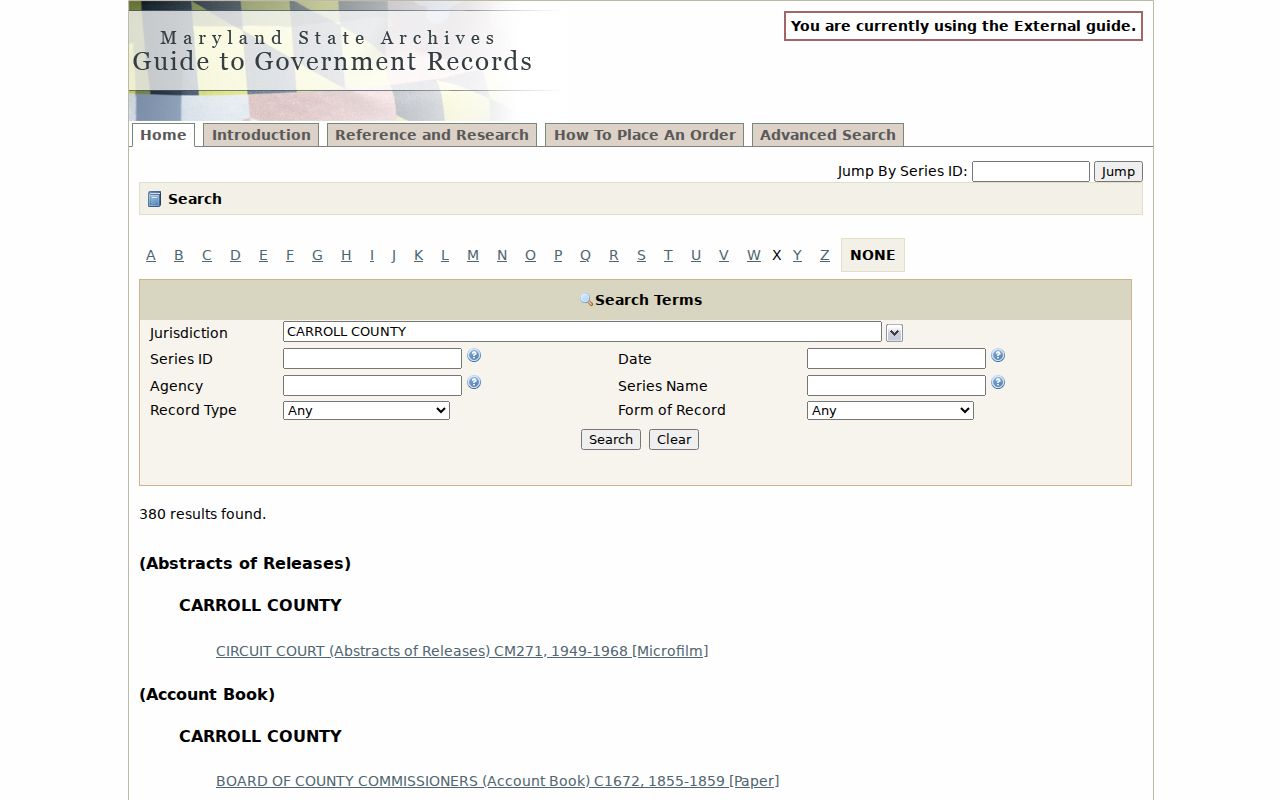
Before 1837, the chain moves into Baltimore or Frederick County records, depending on where the land then lay.
Link Carroll Deeds and Plats
A deed may cite a subdivision, right-of-way, easement, or parent tract. PLATS.NET Carroll lets you search by book, page, plat or box number, right-of-way, date, description, and series.
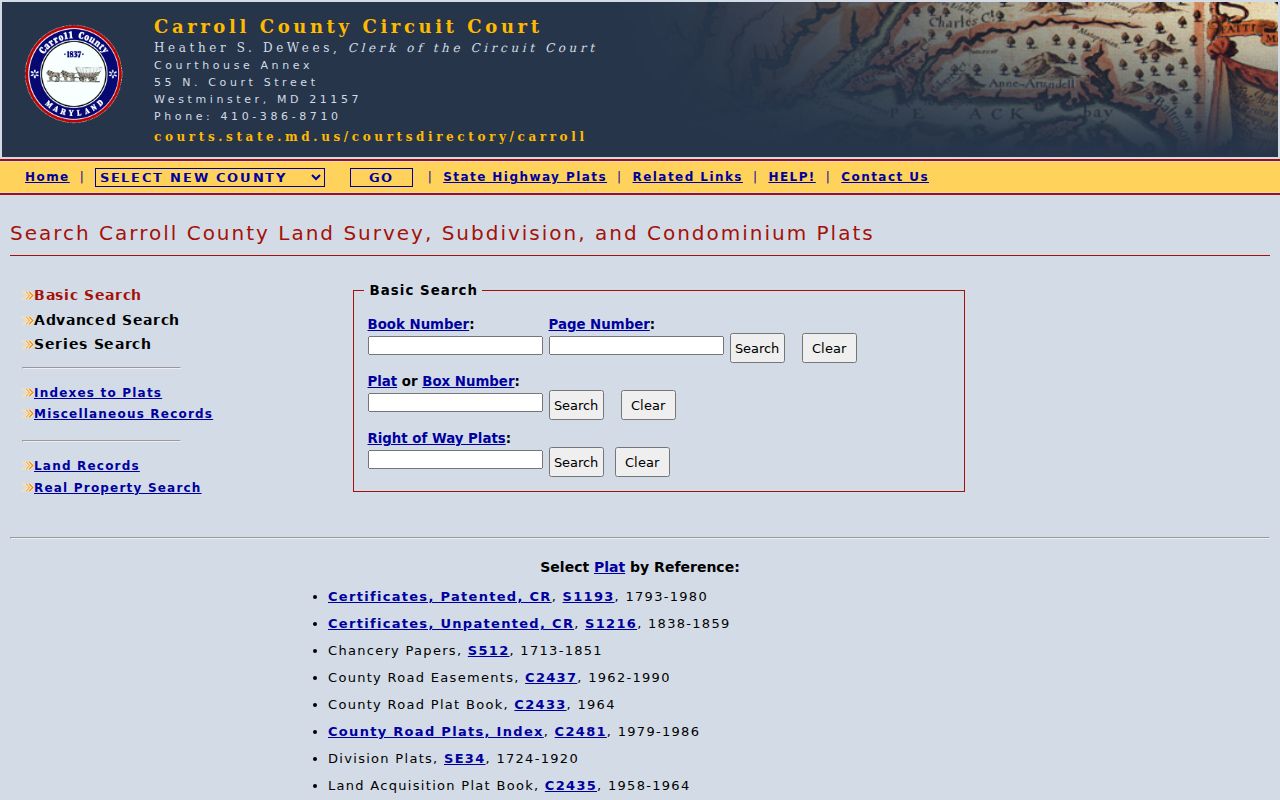
A recorded plat explains lot labels and road dedications, but it is no substitute for a current survey.
Avoid Carroll Copy Mailers
The Clerk warns about mailers charging $99 or $109 for deed copies. According to the office, real copies cost under $10. The county offers no fraud-alert signup, so periodic MDLandRec and SDAT checks are the practical habit. The Clerk warning has the details.
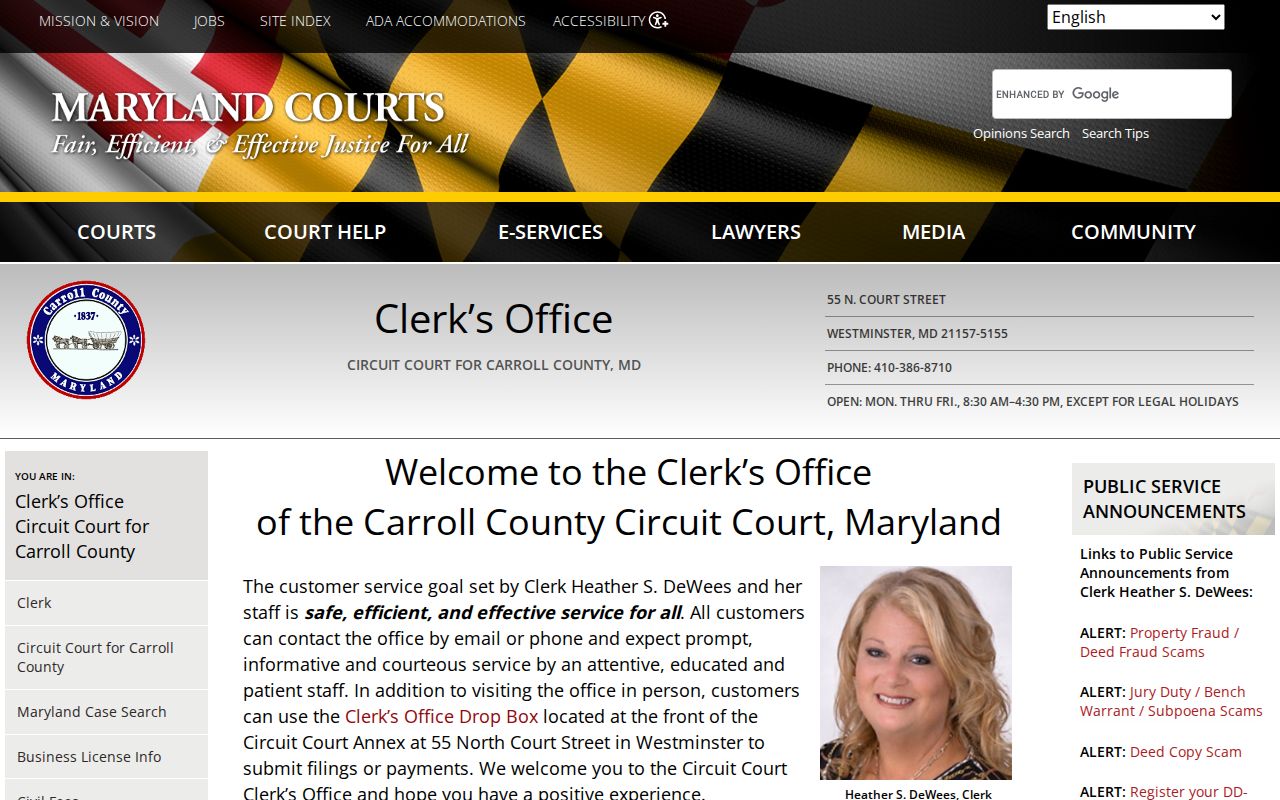
Call Land Records if an unfamiliar instrument appears.
Read Beyond the Deed Index
An index entry is only a locator. Open the image itself and pull the execution and recording dates, every party role, the full legal description, the consideration language. Pull the prior book and page, plat references, reservations, and exceptions. A same-name hit with no matching land is not part of your chain. Remember that one deed can cover several parcels. One parcel can also be touched by several instruments.
Chase the references that matter. These include mortgages, deeds of trust, assignments, releases, easements, restrictive covenants, road agreements, or partial releases. A recorded mortgage is a security interest, not a transfer of beneficial ownership. A missing release signals a title-review question, not proof that a debt is still owed. Court judgments and mechanics liens need extra care. They may require searching both the land index and the Maryland case docket.
Legal descriptions shift form as land gets divided. Match acreage, adjoining owners, road calls, lot and block, subdivision, and the cited plat. A deed may convey only part of a parent tract. Track the residue along with the new lot.
Research Carroll Estate Deeds
A personal representative, trustee, or surviving co-owner can surface in a Carroll County chain. An ordinary sale deed will not explain the reasons. The Carroll Register of Wills estate record identifies the decedent, the representative, and the will. It also lists the docket, inventories, and accounts. Those papers establish authority. Still, the land-record event to match is the later deed. That may be a distribution, survivorship instrument, or court order.
Historic probate sources run deep. The Archives hold Carroll wills indexes from 1837. They also hold wills in microfilm and paper series, inventories reaching into the parent-county era, and estate papers that may sit offsite. When requesting a file, supply name variants and a death range. Include the estate number, the election district or municipality, and a property description. An address on a death certificate is not parcel situs evidence.
Trace Carroll Development History
A land question can branch away from the ownership chain into subdivision history. Carroll Development Review notes that some division questions call for history back to April 23, 1963. That is the day county subdivision regulations took effect. For an unplatted tract, work backward through deeds to that date. Log each off-conveyance, road-frontage change, and remaining portion. For a recorded subdivision lot, the plat may be the key source on that specific point.
The county's community-solar guidance suggests a useful technique. Select a parcel in Parcel Inquiry. Open More Info or Plat Link, then compare the parent tract against the remaining portion. Reconcile the current deed, the legal description, SDAT map data, and the Development Review file. This can explain why two linked accounts carry different plat references without settling any boundary.
Request an Older Carroll Instrument
A dead-end search does not mean the Carroll County deed record is lost. Older land, mortgage, plat, and probate materials sit in several places at once. Some live in electronic series. Others rest in retired indexes, microfilm, paper originals, searchroom holdings, or offsite files. Cite the Archives series number and date span with your request. For Clerk service, include the exact book and page whenever you can.
Ask focused questions before you go. Is the item public? Does retrieval need advance notice? What copy format is offered, and does the deed copy need certification? A broad request should still name the parcel. It should also name the parties, the likely date range, the document class, and any prior reference. The Maryland Public Information Act reaches existing non-routine county files. It does not force an office to build a new chain-of-title report.
Check Mortgages, Liens, and Releases
The Carroll County land records index holds far more than deeds. A deed of trust or mortgage shows a security interest. An assignment can move that interest elsewhere. A release or satisfaction ends the recorded claim. So capture the original reference and every cross-reference along the way. A missing release signals the need for title review. It does not prove money is still owed.
Mechanics liens, homeowners association statements of lien, judgments, tax notices, easements, and covenants each travel their own path. Search Land Records first for the recorded notice. Litigation or a judgment may be involved. Use Maryland Case Search then, and read the public docket and the actual order or filing. A docket status alone never settles the effect on title.
Handle Name and Description Changes
Names shift across a long chain of Carroll County property records. Search married and former names, initials, suffixes, and spelling variants. Corporations, trusts, estates, and merger names matter too. Date controls and the parcel description help separate people who share a name. Role matters as well. A trustee, personal representative, attorney-in-fact, and individual owner do not convey under the same authority.
Descriptions evolve over time just as names do. An early deed may rely on metes and bounds, adjoining owners, and road calls. A later deed may cite a recorded lot and plat instead. Compare acreage and boundary calls rather than assuming a repeated street address proves identity. Road abandonment, annexation, resubdivision, or a partial conveyance can all change the wording. The chain of title still holds.
Use Carroll History Sources Carefully
Older Carroll property records often benefit from historical context. The Historical Society digital library can surface old property names, auctions, construction, or local disputes. The Carroll County Times archive can do the same. The Genealogical Society points to chattel, bond, and insolvency indexes. These may explain a nineteenth-century party. Such sources are good for generating names, dates, and parcel leads.
Always return each lead to the official record. Confirm it in the deed book, grantor-grantee index, plat, estate file, or court record. A newspaper statement is not title evidence. An archive catalog entry proves a series exists, not what a particular instrument says.
Order a Carroll Deed Copy
Give the Clerk the exact book and page or instrument number. State whether you want a plain or certified copy of the deed. Online images, public terminals, and Clerk copies are three distinct routes to the same records. Confirm the current per-page and certification charge before ordering.
Recorded, not guaranteed. Carroll deed records show accepted instruments. They do not rule out unrecorded interests or replace professional title review.